Our Story
Our History
Before the Sea
Stand on the shore at Mor and look out at the Gulf of Khambhat. It looks like it has always been there. It hasn't.
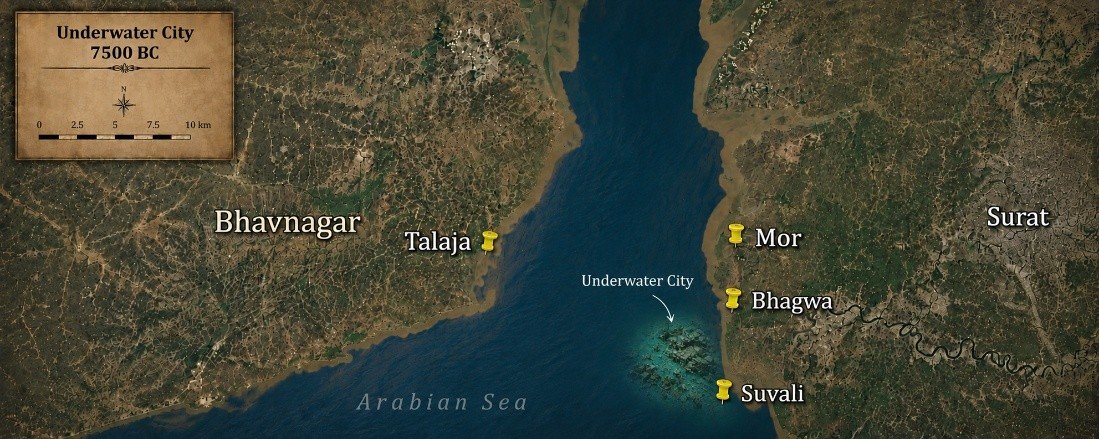
Ten thousand years ago, this gulf did not exist. Where the water sits today was dry land — a wide plain connecting South Gujarat to Bhavnagar on the other side. Then the Ice Age ended, the seas rose, and the land disappeared beneath the water.
The elders have always spoken of a time when people could walk to Bhavnagar. There is even a story of a woman who walked from Bhavnagar to our village to sell milk. That sounded like folklore. The maps of the ancient coastline suggest it was memory.
In 2001, researchers detected what appeared to be a large submerged settlement on the seafloor near Hazira and Suvali — just 27 kilometres from Mor Bhagwa by sea. Artifacts recovered from the site could be around 9,500 years old — among the oldest underwater settlements found anywhere in the world. Where did those people go as the water rose? Perhaps to higher ground. Perhaps to where Mor and Bhagwa stand now.
Nine out of ten elderly residents, unprompted, still speak of Bhagwanagri — a prosperous port city said to have stood where Bhagwa now stands, destroyed by waves from the sea. Even today, at low tide, sandbars appear in the Gulf — shallow enough to remind you the distance to the other side was not always so great.
The Indus Valley on Our Doorstep — 2500 BCE
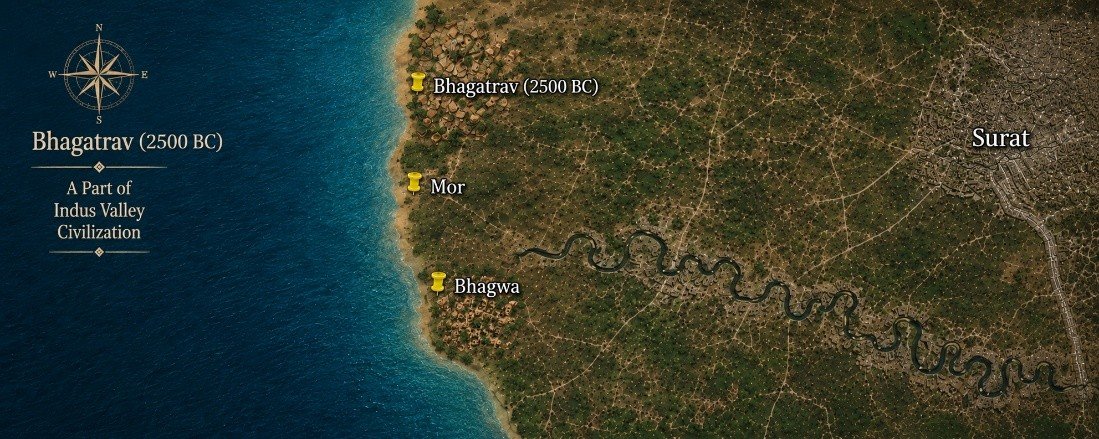
About 12 kilometres from Mor Bhagwa lies Bhagatrav, an ancient site excavated by Dr. S.R. Rao and dated to around 2500 BCE — the height of the Indus Valley Civilisation. The excavations found stone beads, lead pieces, and signs of glazed pottery production. Bhagatrav was likely a port town, similar in character to Lothal, whose dockyard is believed to be the oldest known dock in the world. Our ancestors were not on the edge of that ancient world. They were on its coast, beside its ports, almost certainly part of its trade.
A Village in Royal Records — 1050 AD
The first time our village appears by name in written history, it appears in the records of a king. The copper plate inscriptions of King Trilochanpal, dated 1050 AD, record that the king took a ceremonial bath at Agasti Tirth — the place we know today as Bhagwadandi — and made a royal gift of land from here. A thousand years ago, our village was significant enough to be the site of a king's ceremony.
The Gohil Migration — 1347 AD
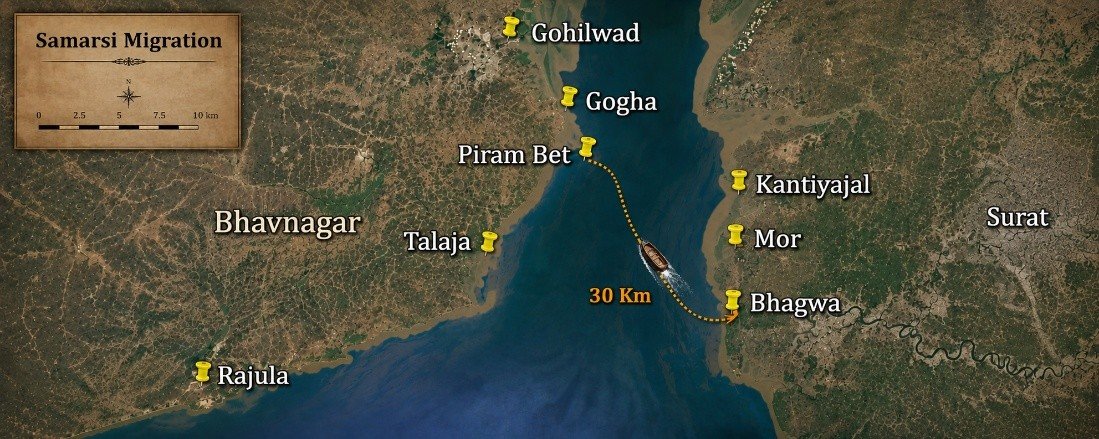
In 1347, after the fall of Piram island in the Gulf of Khambhat, Samarsi Gohil — son of the Rajput chief Mokhadaji Gohil — crossed the Gulf and settled in Bhagwa. The crossing was barely 30 kilometres. He almost certainly did not come alone.
This is not just oral tradition. The Gazetteer of the Bombay Presidency records it. Elders in Bhagwa, in Cape Town, and in family memory across three continents tell the same story: we came from Saurashtra, and we came by sea. An old stone pillar with palace-like carvings still stands in a house in Bhagwa. In the 1930s, a child in the village found a sword and shield hidden in his family's home — carried across the Gulf six hundred years earlier.
A Village of Many Names
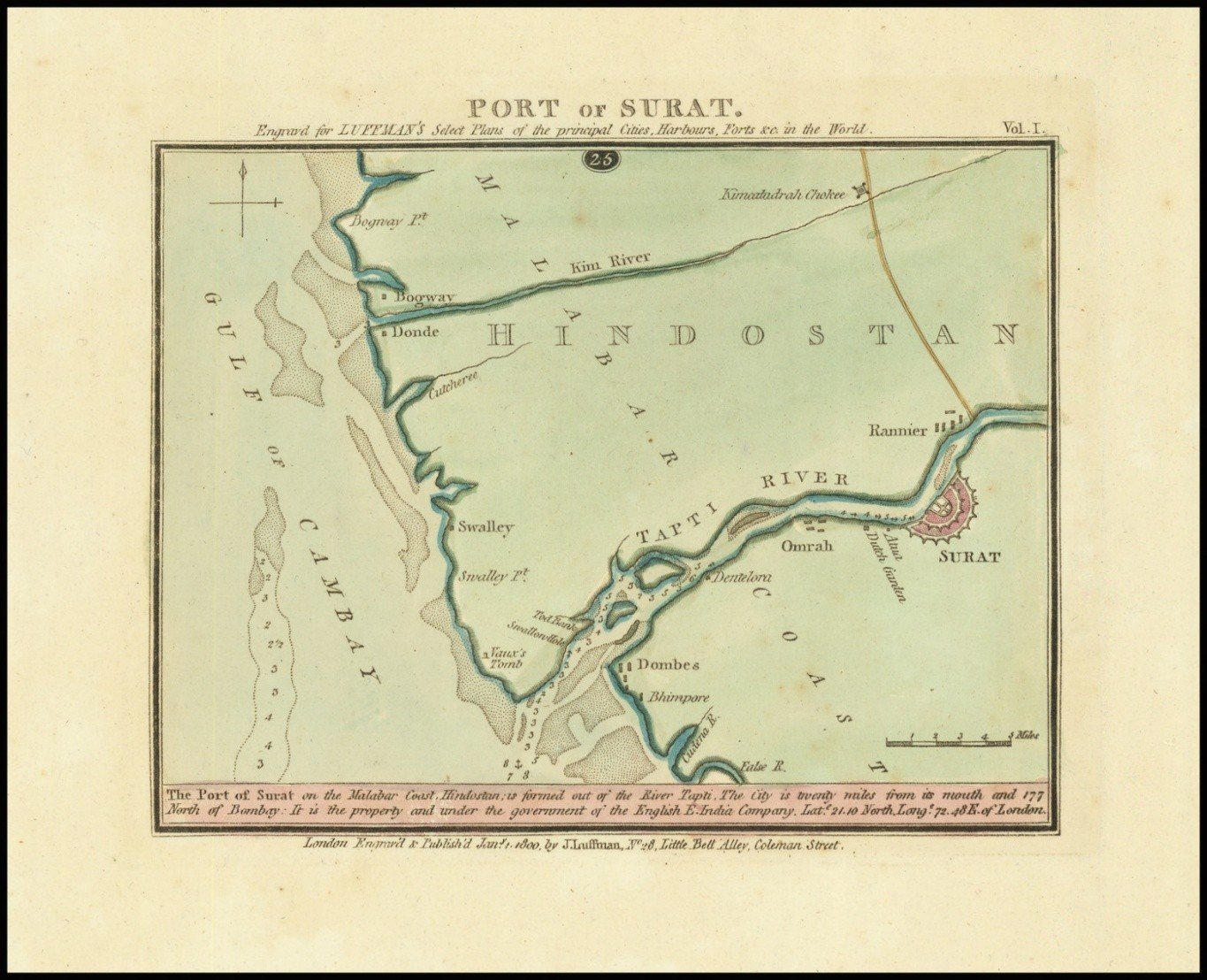
Mughal documents of 1590 call the village Bhankora. British records of 1617 say Backar. Dutch shipping records say Bhekara. By 1690 it appears as Bhagva Dandee. Each name is a different empire's ear trying to catch what the locals said. The village outlasted all of them.
The Sea Was Our Office
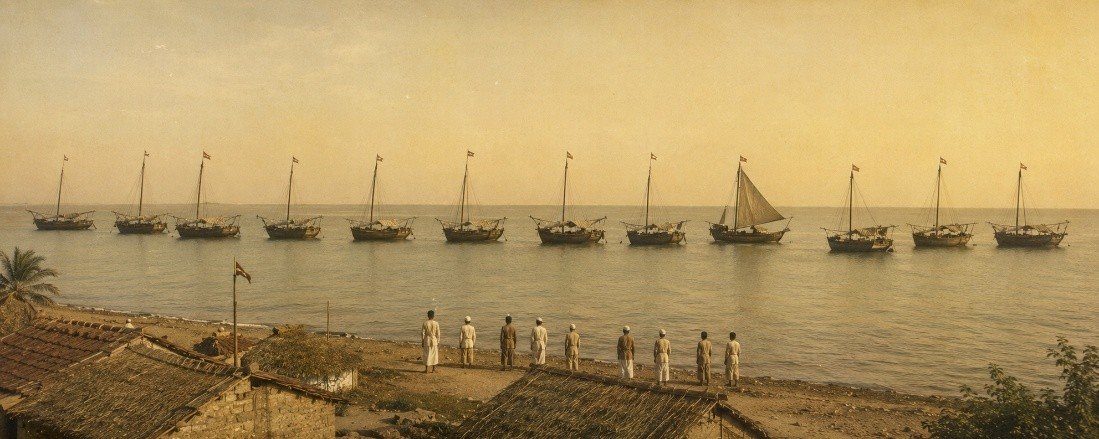
For generations, the men of Mor Bhagwa worked the sea — on fishing boats, on trading vessels, on ships that crossed oceans. The Gulf of Khambhat has the highest tidal range in India — up to twelve metres, twice a day. It is not a forgiving sea. But the men who mastered it became some of the most skilled navigators on the Indian coast: an 1891 American navigation guide warned that foreign ships should not attempt these waters without a pilot from our shore.
The women ran the village. The 1971 census recorded only 43 men for every 57 women in Mor Bhagwa. The missing men were at sea — or in Africa.
Africa — From 1880
Jogi Bava left Bhagwa for Africa around 1880, a sailor who found his way to African shores through the work his hands had always known. He sold cloth door to door, returned with his earnings and his stories, and went back. Around 1900 he sent for his son. One man became two. Two became a pattern. Over the following decades, families from our villages built lives in Kenya, Tanzania, Zimbabwe, and South Africa.
When Africa Changed
From the 1960s onward, political change across East and Southern Africa pushed many of our families to move again — this time to Britain. A community that had already crossed one ocean crossed another. Today our people live in Surat, across India, in the UK, Africa, Australia, Canada, and the United States — approximately 26,000 of us worldwide.
Today
Most of the community has moved away from the villages. The streets that were once full are quieter now. But the temple stands, the fadias stand, and the sea is still visible from most lanes. The village was full once — and the record of that fullness is what this community works to preserve.